Vinsobres, the altitude that refines the southern Rhône
A red cru from the Drôme provençale, Vinsobres combines southern sunshine, hillside vineyards at altitude, and a structured expression of Grenache, Syrah and Mourvèdre.
geoVINUM · 2026-11-04
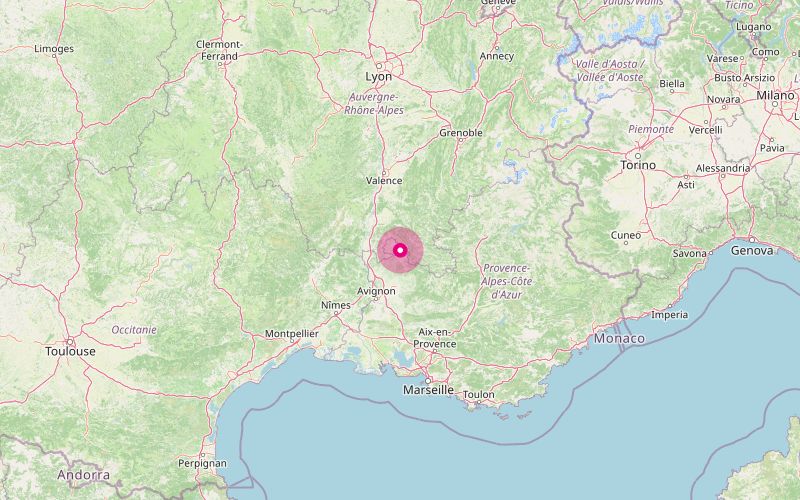
## Vinsobres at a glance Vinsobres is a cru of the Côtes du Rhône located in the Drôme provençale, northeast of Nyons, in the northern part of the southern Rhône. The appellation attained the status of communal AOC in 2006, after a long history within Côtes du Rhône Villages. It produces exclusively red wines, which clearly sets it apart within a southern landscape where communal appellations may cover several colors. Its identity is rooted in hillside vineyards lying between roughly 200 and 450 meters in altitude, a high elevation for the area, which imparts a noticeable freshness to the wines' profile.
The vineyard is concentrated around the commune of Vinsobres, on well-exposed slopes, mainly facing south and southeast. This position combines good phenolic ripeness with more pronounced temperature swings than in the neighboring plains. The cru enjoys a solid reputation for reds that are at once dense, spicy and structured, capable of aging with poise. Among the southern crus, Vinsobres stands out less for solar opulence than for a fresher, more energetic interpretation of the southern Rhône.
## Terroir and geology The relief of Vinsobres is essential to understanding the cru. The vineyard rises across hillsides and terraces that mostly face south and southeast, with sometimes marked slopes and a mosaic of different situations. This topography favors sunshine exposure while partly avoiding the excess heat of the valley floors. It also contributes to air circulation, a useful factor for the sanitary condition of the grapes.
The soils are varied, as is often the case in the Rhône, but they share a logic of drainage and depth modulated according to the sector. There are stony formations and calcareous scree, marls, clays and rocky debris mixed with gravelly elements. Rounded pebbles exist locally, but they alone do not define the cru, whose soil reality is more composite. Limestone, in its different forms, plays an important role in water balance and in the perceived tension of the wines.
The more clay-rich parcels often give fuller-bodied reds, with more volume on the palate and a firmer tannic foundation. More stony or more calcareous zones tend to produce straighter, pepperier and sometimes more floral expressions. This diversity allows producers to blend complementary lots, or conversely to isolate certain origins in single-parcel cuvées. The notion of terroir in Vinsobres therefore does not refer to a single soil, but to the interplay between altitude, exposure and geological diversity.
## Climate The climate is fundamentally Mediterranean, with dry, bright and windy summers, as well as a late season that is often favorable to the full ripening of red varieties. The mistral regularly helps keep the vines healthy after humid episodes, limiting the pressure of certain fungal diseases. The area benefits from a good level of sunshine, essential to the ripening of Grenache, the central variety of the appellation. The soils' water reserves and the altitude nevertheless play a buffering role against episodes of drought.
Compared with other areas of the southern Rhône, Vinsobres stands out for cooler nights and more marked diurnal temperature shifts. This temperature gap slows the degradation of acids and helps preserve a form of aromatic precision. It partly explains why the wines often seem less warm than their richness might suggest. This relative freshness is one of the cru's most consistent hallmarks.
Hot vintages can yield very ripe wines, but the altitude generally provides a welcome margin of safety. In later or windier years, Syrah and Mourvèdre take on a particularly useful structuring role in blends. Climate change reinforces the agronomic value of these higher hillsides, where the balance between sugars, tannins and acidity remains easier to preserve. Vinsobres thus appears as a particularly relevant southern cru in the current context.
## Grape varieties The appellation is devoted to reds made from the southern Rhône grape palette. Grenache noir is the usual base of the blends, bringing flesh, natural alcohol, dark fruit and an enveloping texture. Syrah plays a decisive role in color, tannic structure, aromatic freshness and notes of violet, pepper or black olive. Mourvèdre completes the whole with depth, tight tannins and added aging potential.
The specifications follow the logic of southern crus dominated by Grenache, supported by Syrah and Mourvèdre. Depending on the estate and the sector, the balance varies significantly: some cuvées favor the roundness of Grenache, while others seek a more vertical expression by increasing the share of Syrah. The permitted accessory varieties exist in the regional tradition, but they generally remain secondary in the wines' final profile. In practice, the sensory identity of Vinsobres is almost always built around the Grenache-Syrah-Mourvèdre trio.
Viticultural choices strongly influence style. Grenache, sensitive to water stress and coulure, requires planting adapted to soils and exposures. Syrah performs well in cooler, more ventilated sectors, where it retains its aromatic brightness. Mourvèdre, which ripens later, benefits from warm exposures and extended autumns, without always occupying a majority place.
## Wine styles Vinsobres produces only reds, and this exclusivity contributes to the clarity of the cru. The most common style combines ripe black fruit, notes of garrigue, sweet spices, pepper, sometimes licorice, with a full palate held together by a fresh backbone. The tannins are present, often tight in youth, especially when Syrah or Mourvèdre play an important role. Even in generous versions, the dominant impression is not that of a heavy red, but of a sun-filled wine framed by its altitude.
Vinifications vary in extraction according to each estate's project. Some producers favor aging in concrete tanks or large vessels in order to preserve the fruit and the expression of the hillsides. Others make partial use of barrels or demi-muids to soften the texture and gain complexity, without seeking dominant oak. The best examples avoid overripeness and élevage makeup, two options that easily blur the singularity of the cru.
The aging potential is real. Entry-level cuvées can be enjoyed on their fruit after a few years, while more ambitious selections often benefit from waiting five to ten years, sometimes more in great vintages. With evolution, the fruit shifts toward black cherry, plum and dried fig, while notes of fine leather, resin, thyme and undergrowth emerge. The tannic structure, fairly firm at the outset, then tends to meld without losing the framework that gives the wines their staying power.
## Producers to watch - Domaine Jaume: a consistent benchmark of the appellation, with precise, full-bodied wines well sustained by freshness. - Domaine de Montine: an accessible and serious reading of Vinsobres, often marked by clean fruit and controlled tannins. - Domaine Chaume-Arnaud: an organically farmed estate, sought after for its balanced, fine reds that express the terroir. - Domaine du Coriançon: a straightforward and consistent style, centered on ripe fruit and structure without excess. - Domaine Saint-Vincent: a historic producer in the area, with cuvées that clearly show the local aging potential. - Domaine Autrand: a reliable address for grasping the diversity of Vinsobres expressions through carefully crafted blends.
## Food and wine pairings Vinsobres calls for cuisine built on texture and savory juices more than for light dishes. Its tannic structure, ripe fruit and accents of dried herbs suit dishes in which meat, reduced juices and Mediterranean aromatics play the leading role. The cru's relative freshness also helps it avoid saturation with long-cooked preparations. It works particularly well in the following pairings:
- Roast leg of lamb with thyme, garlic and black olives.
- Daube provençale with olives, carrots and orange zest.
- Duck breast served pink with a mild spice reduction.
- Grilled rib of beef, short jus and roasted apples.
- Lamb tagine with prunes, provided the dish's sweetness is kept in check.
- Aged ewe's milk tomme or lightly matured farm Saint-Nectaire.
## FAQ ### Is Vinsobres a Côtes du Rhône village or a cru? Vinsobres is a cru of the Côtes du Rhône, meaning a communal appellation in its own right. It obtained this status in 2006, after previously being recognized as Côtes du Rhône Villages.
### Why is Vinsobres often described as fresher than other southern Rhône reds? The altitude of the hillsides and the cooler nights largely explain this perception. They allow the wines to retain more tension and aromatic precision despite a well-sunned southern climate.
### Does the appellation produce rosé or white wine? No, Vinsobres produces exclusively red wines. This specialization reinforces the identity of the cru and focuses its image on blends based on Grenache, Syrah and Mourvèdre.
### What is the typical aromatic profile of a Vinsobres? One often finds aromas of blackberry, black cherry, plum, licorice, pepper and garrigue. With age, notes of leather, black olive, dried spices and undergrowth may appear.
### At what age should a Vinsobres be drunk? Simple cuvées show well after a few years in bottle, when the tannins begin to relax. Terroir-driven or oak-aged cuvées often require more patience and can develop favorably over a decade or even longer depending on the vintage and the producer.