Vino Nobile di Montepulciano, the other great Tuscan red
In Montepulciano, Prugnolo Gentile yields structured, nuanced reds. This historic Tuscan DOCG combines local tradition, a precise regulatory framework, and genuine aging potential.
geoVINUM · 2026-11-04
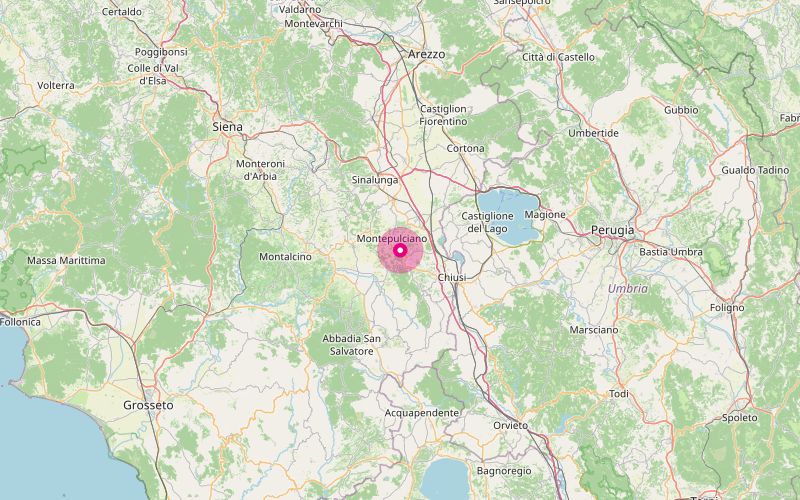
## Vino Nobile di Montepulciano in brief Vino Nobile di Montepulciano is a Tuscan DOCG appellation produced around the commune of Montepulciano, in the province of Siena, in the southeast of the region. The area is devoted to still red wines, with two main categories recognized by the production regulations: Vino Nobile di Montepulciano and Vino Nobile di Montepulciano Riserva. The appellation obtained DOC status in 1966 and then DOCG in 1980, making it one of the first Italian reds to be elevated to this rank. Vineyard area and volumes vary according to vintages and declarations, but the productive zone remains moderate in scale compared with the major Tuscan appellations, which helps preserve a clearly legible communal cru identity.
The name is regularly confused with the Montepulciano grape variety grown mainly in Abruzzo. Here, the wine does not derive its identity from that grape, but from its place of production and from Prugnolo Gentile, the local biotype of Sangiovese. This distinction is essential to understanding the wine’s style, which is closer to the family of great Tuscan Sangiovese than to Montepulciano-based reds from central Adriatic Italy. Vino Nobile thus occupies a middle ground between the classical firmness of certain Chianti Classico and the often broader depth of Brunello di Montalcino.
## Terroir and geology The vineyard stretches across the hills surrounding Montepulciano, generally between about 250 and 600 meters in altitude. Varied exposures, breaks in slope, and the proximity of valleys create a mosaic of situations that nuance ripening patterns. The highest parcels tend to produce more taut, more floral wines, while warmer, better-sheltered sectors give fleshier expressions. This diversity explains the growing interest in a parcel-by-parcel reading of Vino Nobile.
From a geological standpoint, the area cannot be reduced to a simple galestro-alberese duo, as is sometimes described for other Tuscan zones. There are soils of marine and fluvial origin, with clays, sands, silts, calcareous deposits, and conglomerates, plus locally stony elements. Clays favor water retention and mid-palate density, while sandy and calcareous fractions can refine the tannic profile and lift the aromatic register. The relationship between soil and style nevertheless remains dependent on plant material, rootstocks, crop load, and harvest-date choices.
The vineyard landscape alternates between vines, olive groves, woods, and cultivated land. This heterogeneity partly limits the effects of monoculture and contributes to a certain sanitary ventilation of the parcels. It also maintains a historic agricultural setting consistent with the image of Montepulciano, a Renaissance town perched above its slopes. For the taster, this setting translates less into a uniform flavor than into a recurring combination of structure, freshness, and tight tannic grain.
## Climate The climate is temperate continental with Mediterranean influence, marked by hot summers, notable diurnal swings, and winters that are cooler than on the Tuscan coast. Altitude brings relatively cool nights during the ripening phase, which helps preserve acidity and slow aromatic development. Winds play an important role in drying the bunches after rain and in moderating thermal extremes. The vegetative cycle of Sangiovese nevertheless remains exposed to the classic hazards of central Italy: unstable springs, episodes of summer heat, and late-season rain.
In balanced vintages, these conditions favor progressive phenolic ripeness and good tannin definition. In hot years, the water-retention capacity of clay soils can prevent overly severe hydric stress, but the risk of rapid ripening and rising alcohol levels remains. Conversely, cooler or wetter years require rigorous sorting and careful extraction management to avoid hardening the wines. The final style therefore depends as much on the year’s climate as on the producer’s interpretation.
## Grape varieties The central grape variety is Prugnolo Gentile, the local name for Sangiovese in Montepulciano. The production regulations require a clear majority of Sangiovese, generally set at a minimum of 70% in the blend. The remainder may come from other authorized red varieties in Tuscany, within the limits laid down by the regulations. Historically, Canaiolo Nero, Colorino, and Mammolo have played a supporting role, notably to adjust color, perfume, or suppleness.
In contemporary practice, many producers significantly increase the share of Prugnolo Gentile, some going as far as single-varietal expression. Others retain small proportions of traditional Tuscan varieties to add complexity without diluting the cru’s identity. The use of international varieties, once more visible in several Italian regions, now tends to be approached with greater restraint when the goal is to preserve territorial signature. This evolution goes hand in hand with more precise work on massal selections, clones, and grape-parcel suitability.
Rosso di Montepulciano, a neighboring appellation often produced by the same estates, should not be confused with Vino Nobile. It generally offers a simpler, earlier-drinking expression and is less constrained by aging requirements, even though its quality level can be high. For Vino Nobile, the issue is not only fruit ripeness, but the balance between richness, tension, and tannic definition. Prugnolo Gentile then shows its aptitude for finely conveying vintage and site differences.
## Wine styles Vino Nobile di Montepulciano is a structured dry red built on fruit notes of cherry, morello cherry, and red or black plum, often accompanied by floral notes, dry earth, tobacco, Mediterranean herbs, and sweet spices. In the most classical versions, the palate favors straightness, measured alcohol, and firm but integrated tannins. Aging in large oak vessels tends to preserve this restrained, saline register. More modern approaches, with heavier extraction and more marked new oak, still exist but no longer define the appellation as a whole.
The production regulations require minimum aging before release, longer for Riserva than for the basic cuvée. Without entering into month-by-month detail, which may evolve with regulatory updates, the key point is that Riserva spends more time in cellar and aims for a deeper profile with greater aging capacity. Some producers also offer parcel selections or estate cuvées that do not constitute a separate official designation, but reflect more targeted work. Quality level then depends as much on the relevance of the parcel as on the length of élevage.
The best Vino Nobile combine flesh, acidity, and length, with aromatic development toward fine leather, dried leaf, light truffle, and spice. Entry-level bottlings can be approachable in youth after decanting, but more ambitious versions often benefit from aging. In a good vintage, cellaring can extend over a decade and beyond for the most successful Riserva wines. Texture quality remains a decisive marker: a great Vino Nobile should age by refining itself, not by drying out.
## Producers to watch - Avignonesi: a benchmark estate in the area, known for precise interpretations and ambitious agronomic work. - Boscarelli: a historic producer whose cuvées combine consistency, tannin finesse, and clear terroir expression. - Poliziano: an important address in the appellation, with a style that is often clean and approachable without giving up structure. - Salcheto: an estate recognized for its environmental commitment and its taut wines, often driven by beautiful freshness. - Bindella: a serious house whose Vino Nobile show convincing balance between fruit, élevage, and food-friendliness. - Lunadoro: a producer appreciated for frank, territorial wines that highlight Prugnolo Gentile without excessive oak.
## Food and wine pairings Vino Nobile pairs very well with pappardelle al ragù di cinghiale. The acidity of Sangiovese supports the long-cooked sauce, and the tannins match the texture of the wild boar without dominating the dish.
Roast lamb with herbs, served with potatoes and root vegetables, makes for a solid pairing. The notes of rosemary, sage, and the meat’s slight sweetness echo the wine’s spicy, earthy register.
Bistecca alla fiorentina works particularly well with a structured version or a Riserva. The density of the meat, the Maillard reaction, and the juiciness of the cut absorb the wine’s tannic firmness.
Aged hard cheeses, such as a few-month-old Tuscan pecorino, offer a classic pairing. The salt and fat smooth the tannic feel and highlight aromas of stone fruit pit, tobacco, and undergrowth.
Roast poultry with mushrooms, especially when the garnish includes porcini or oyster mushrooms, suits a more evolved Vino Nobile. The pairing relies on the continuity between the wine’s tertiary notes and the dish’s umami character.
## FAQ ### Is Vino Nobile di Montepulciano made from the Montepulciano grape? No. The name refers to the town of Montepulciano in Tuscany, while the main grape variety is Prugnolo Gentile, the local biotype of Sangiovese. It is one of the most frequent confusions in the Italian vineyard.
### What is the difference between Vino Nobile and Rosso di Montepulciano? Rosso di Montepulciano is generally simpler, softer, and released earlier. Vino Nobile is subject to stricter aging requirements and aims more for depth, structure, and cellaring potential.
### At what temperature should Vino Nobile di Montepulciano be served? A range around 16 to 18°C is suitable in most cases. Young, concentrated cuvées often benefit from decanting to soften the tannins and clarify the bouquet.
### How long can a Vino Nobile age? Basic cuvées drink well in the years following their release, depending on the estate’s style and the vintage. The best bottles, especially in Riserva, can evolve favorably for ten to fifteen years, sometimes longer.
### Is the style close to Brunello di Montalcino? The two wines share the DNA of Tuscan Sangiovese, but their expressions differ because of place, soils, production choices, and blending rules. Vino Nobile often appears a little less massive than some Brunello, with a more supple articulation and a very distinct territorial reading.