Valpolicella, the Matrix of Verona’s Reds
Between limestone hills, ventilated valleys, and grape drying, Valpolicella offers reds ranging from light wines to ageworthy Amarone.
geoVINUM · 2026-11-04
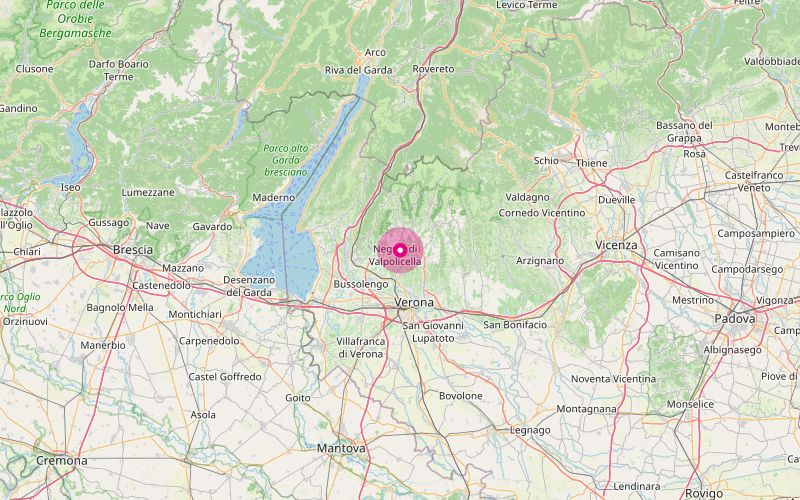
## Valpolicella in brief Valpolicella is a historic appellation of Veneto, located northwest of Verona, between the Adige, the Lessini mountains, and the moderating influence of Lake Garda. The Valpolicella DOC appellation was recognized in 1968, while Amarone della Valpolicella was elevated to DOCG status in 2010, as was Recioto della Valpolicella. The area mainly produces dry red wines, but also a great sweet red wine, Recioto, as well as Ripasso versions resulting from a specific aging practice. The area includes Valpolicella Classica in the west, Valpantena in the center, and the eastern extension known as allargata, together accounting for significant volume and a very legible qualitative hierarchy.
## Terroir and geology The landscape of Valpolicella is formed by a succession of valleys running north to south, open toward the Veronese plain. This topography channels airflows, multiplies exposures, and creates a mosaic of slopes, ledges, and terraces where vines alternate with olive and cherry trees. Altitudes generally range from the foothills to the higher slopes of the Lessini foothills, offering significant differences in ripening depending on the sector. The historic boundaries of the Classica, which notably include Fumane, Marano, and Negrar, remain the most frequently cited reference for the most renowned sites.
The geology is complex and is central to understanding the wine profiles. One finds marine limestone, marl, brown soils over limestone bedrock, volcanic and basaltic formations in certain sectors, as well as alluvial and morainic deposits lower in the landscape. Limestone and marl soils tend to favor taut, floral, and saline expressions, while more clay-rich zones often yield fuller palates. Basaltic terroirs, less extensive but important, are regularly associated with darker, spicier, and more nervy profiles.
The structure of the vineyard has also evolved with training systems. The pergola veronese, long dominant, protects the bunches from direct sun and suits the production of grapes intended for appassimento, as it can preserve acidity and limit sunburn. Many estates also use guyot, especially on parcels where better yield control and greater concentration are sought. In a region where the raw material serves very different styles, the choice of training system and crop load is never neutral.
## Climate Valpolicella has a temperate continental climate with softening influences from Lake Garda to the west and the plain to the south. Winters can be cold, but remain less severe than in more enclosed areas of northern Italy, while summers are warm without being uniformly torrid on the slopes. The valleys benefit from regular ventilation, which reduces part of the disease pressure and promotes gradual ripening. Altitude and exposure play a decisive role, as they help preserve freshness in a region that might otherwise tip into overly ripe profiles.
Rainfall is sufficient to sustain the vine, but its distribution and the soils’ available water reserve are crucial. Well-drained limestone sectors require particular vigilance in summer, whereas more clay-rich soils better buffer drought episodes. Harvests intended for classic Valpolicella seek a balance between sugar, acidity, and phenolic ripeness, while grapes destined for appassimento must have healthy skins and high natural concentration. In this context, canopy management, harvest date, and vineyard sorting are among the most sensitive decisions of the annual cycle.
The drying of grapes after harvest is an integral part of the regional winegrowing climate, even if it takes place outside the vineyard. The bunches are traditionally placed in airy rooms, now often better controlled, in order to avoid the development of undesirable rots. This stage requires sufficiently healthy autumns and perfectly intact fruit, which explains the attention paid to parcel and lot selection. An estate’s ability to master appassimento weighs as heavily on the quality of an Amarone or a Recioto as the terroir itself.
## Grape varieties The identity of Valpolicella rests first on Corvina, often joined by Corvinone, now clearly distinguished ampelographically and no longer considered a simple biotype. Corvina brings aromatic finesse, notes of tart cherry, moderate tannins, and a skin well suited to drying. Corvinone readily contributes structure, spice, and palate volume. Together, they form the backbone of the area’s best blends.
Rondinella is the appellation’s second historic pillar. It is appreciated for its consistent yields, color, sound sanitary behavior, and suitability for appassimento, even if its aromatic expression is generally less complex than that of Corvina. Other native or traditional varieties complete the blends, including Molinara, long more present than it is today, as well as Oseleta in certain wines seeking more color and tannin. Depending on the regulations and producers’ practices, a small share of other authorized grape varieties may be included, but the qualitative hierarchy clearly rests on the trio of Corvina or Corvinone, Rondinella, and, more occasionally, Molinara.
Blending rules vary according to the denominations within the Valpolicella family, but Corvina or Corvinone must in principle represent the base of the wine. The best producers seek less a fixed recipe than a balance of perfume, freshness, texture, and aging potential. Corvina provides momentum, Rondinella secures the blend, and accessory grapes adjust or refine according to the vintage. This flexibility explains the diversity of styles within the same geographical area.
## Wine styles Valpolicella DOC in its simplest form is a dry red, light- to medium-bodied, focused on red fruit, flowers, and a fresh framework. It emphasizes notes of morello cherry, crunchy cherry, sometimes sweet pepper and dried herbs, with generally supple tannins. Superiore versions require higher alcohol and longer aging, yielding more structured wines that can benefit from a few years in bottle. In the best cases, especially in Classico or from well-situated slopes, the style can gain depth without losing drinkability.
Valpolicella Ripasso DOC is obtained by bringing a Valpolicella back into contact with still-rich pomace from Amarone or Recioto. This practice restarts fermentation and increases body, alcohol, glycerol, and aromatic complexity, while in principle preserving more freshness than an Amarone. Ripasso can be very convincing when based on a serious base wine and measured aging. It drifts toward heaviness, however, if one tries to artificially imitate Amarone without the necessary precision.
Amarone della Valpolicella DOCG is the region’s great dry wine, made from grapes dried for several months according to the appassimento technique. This process concentrates sugars, extractable matter, and aromatic compounds, then fermentation is carried through until much of the sugar is depleted, hence a powerful but dry wine. Typical aromas combine black cherry, plum, fig, cocoa, spices, tobacco, and sometimes a balsamic nuance. The best Amarone withstand long aging thanks to their density, preserved acidity, and tannic structure.
Recioto della Valpolicella DOCG is the historic sweet counterpart, predating Amarone in the region’s history. It too comes from dried grapes, but fermentation is stopped before the sugars are fully consumed, leaving a balance of richness, sweetness, and freshness. The most successful profiles avoid any sense of heaviness thanks to clear acidity and still-legible fruit. It remains a more confidential style, but one that is essential to understanding the original logic of Valpolicella.
Aging varies greatly depending on the style and the estate’s philosophy. Basic Valpolicella often favors stainless steel or large vessels to preserve fruit brightness, while Ripasso, Superiore, and Amarone more readily see time in large casks, botti, or barriques. The use of new oak is a stylistic choice, not a qualitative obligation, and the most precise producers use it with restraint. In terms of cellaring, an entry-level Valpolicella is best drunk young, whereas a great Amarone can evolve favorably for more than a decade.
## Producers to watch - Allegrini : benchmark estate of the Classica, known for precise Amarone and cuvées that have contributed to the appellation’s international renown. - Tommasi : historic house offering a classic and consistent reading of Valpolicella, Ripasso, and Amarone, with broad distribution without abandoning regional style. - Quintarelli : cult producer in Negrar, famous for highly complex wines, aged for a long time, that have shaped the most patient and artisanal image of Amarone. - Masi : major regional player, a pioneer in promoting appassimento and the Amarone category on international markets. - Tedeschi : firmly established family estate, appreciated for readable wines faithful to the nuances of the valleys of the Classica. - Speri : benchmark for organic farming in the classic zone, producing balanced Valpolicella and Amarone, often cited for their purity of fruit.
## Food and wine pairings Dry red Valpolicella pairs well with a light pasta all’amatriciana, delicate charcuterie, or mushroom risotto, as its freshness supports the dish without weighing it down. A Valpolicella Superiore suits roast poultry with herbs, lasagna al ragù, or a grilled veal chop. Ripasso works with braised meats, osso buco, or eggplant parmigiana, thanks to its extra body and spice.
Amarone calls for more concentrated dishes, such as wild boar stew, long-cooked beef cheek, or a piece of aged parmesan. It can also pair at table with preparations whose reduction and texture answer the wine’s density. Recioto della Valpolicella finds its place with a dark chocolate dessert, a morello cherry tart, or certain mild blue cheeses. In all cases, serving temperature and moderation of extraction in the cooking matter as much as the theoretical pairing.
## FAQ ### Is Valpolicella always a light wine? No. Basic Valpolicella DOC is often light- to medium-bodied, but the appellation’s family of wines also includes fuller-bodied Ripasso and very structured Amarone. The name therefore refers to a shared origin, not to a single wine format.
### What is the difference between Amarone and Ripasso? Amarone is made directly from dried grapes and then vinified dry. Ripasso starts from an already vinified Valpolicella, brought back into contact with Amarone or Recioto pomace to gain concentration and complexity.
### Is Recioto the ancestor of Amarone? Yes, in the historical sense. Recioto, a sweet wine from dried grapes, is the region’s old style, while Amarone was born from a fermentation carried further, until it produced a dry and powerful wine.
### Do you necessarily have to wait before drinking an Amarone? Not always. Some Amarone are accessible relatively young thanks to controlled extraction and aging, but ambitious cuvées often gain cohesion after several years. The producer’s style and the vintage are decisive.
### Which area is the most renowned in Valpolicella? Valpolicella Classica concentrates the historic renown and a high density of benchmark producers. That said, Valpantena and certain sectors of the extended area can deliver very serious wines when the sites and viticultural practices are up to the mark.