Swartland, the Cape’s dry and precise laboratory
North of the Cape, Swartland has established itself through its old dry-farmed vines, varied soils, and a contemporary reading of Chenin Blanc and Syrah.
geoVINUM · 2026-11-04
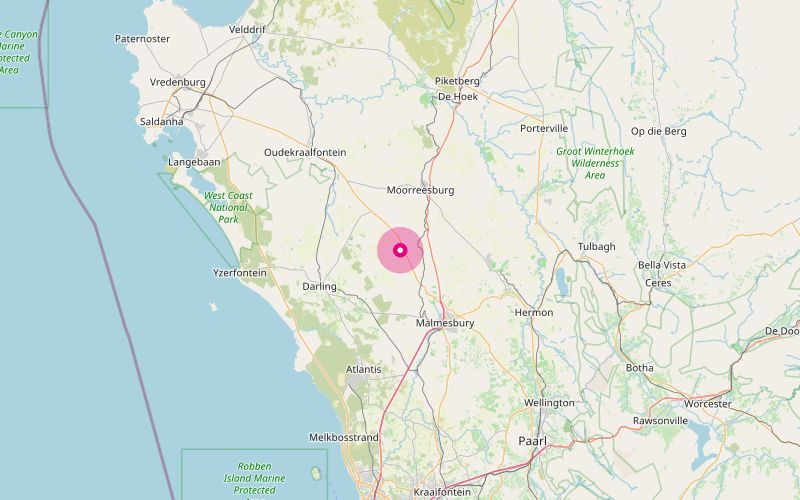
## Swartland in brief Swartland lies north of Cape Town, in the Coastal Region of the Western Cape, between Malmesbury, Riebeek-Kasteel, Darling, and the inland fringe that rises toward Piketberg. From a regulatory standpoint, Swartland is a recognized South African wine district within the Wine of Origin system; it is therefore not an appellation in the European sense, but a delimited and controlled origin. The region produces white, red, and rosé wines, with a particularly strong reputation for Chenin Blanc, Syrah, and several Mediterranean blends. The wine landscape remains closely tied to old dry-farmed bush vines, low-intervention viticulture, and a fine-grained reading of individual sites.
The name Swartland, literally “black land,” refers to the dark hue once taken on by the land covered with renosterbos after the winter rains. Long oriented toward grain farming, the region supplied large volumes to the cooperative before becoming, from the 1990s and especially the 2000s onward, a major center for wines of place, variety, and authorship. This transition was driven by producers working with old, often neglected parcels, rather than by a spectacular expansion of the vineyard. Swartland now occupies a central place in the quality identity of South African wine.
## Terroir and geology Swartland’s geological foundation is ancient and varied, with a dominance of schist and granite, joined locally by soils derived from the sandstone of the Table Mountain Group. This diversity is a key point, because it allows for very distinct expressions over short distances, particularly between the more granitic zones around Paardeberg and the more schistous sectors toward Kasteelberg. Granite often yields whites that are more airy, saline, and taut, while schist is frequently associated with tighter structures and darker reds. The soils are generally poor, well-draining, and low in fertility, which naturally limits vine vigor.
The Paardeberg massif plays a structuring role in understanding the local terroir. Its granitic slopes host a large number of old Chenin Blanc vines, often bush-trained and grown without irrigation. Kasteelberg, a more compact and more schistous hill, is more often cited for Syrah, Mourvèdre, or southern-style blends with a firmer, spicier profile. Between these poles, the rolling landscape of Swartland forms a mosaic of parcels where altitude, exposure, and soil depth noticeably alter grape ripening.
The presence of many old vines is one of the region’s most serious hallmarks. South Africa maintains an inventory of old vines, generally from 35 years onward, and Swartland contains a significant share of them, notably in Chenin Blanc, Colombard, Cinsault, and Sémillon. These vines, often dry-farmed and deeply rooted, deliver moderate and regular yields rather than caricatural concentration. Above all, they bring stability of ripeness, a particular texture, and the ability to transmit site differences.
## Climate Swartland’s climate is typically Mediterranean, with cool to mild, rainy winters followed by long, dry, bright summers. Rainfall is concentrated largely in the cold season, making the soils’ water reserves and deep rooting decisive during ripening. Summer heat is real, but it does not automatically translate into heavy wines, because several factors help modulate thermal stress. The main issue is not absolute freshness, but the vineyard’s ability to ripen slowly without excessive irrigation.
Maritime influence plays a subtler role than in zones closest to the ocean, but it remains important. Atlantic breezes, especially from the Darling coast and more broadly from the west, can temper certain days and help preserve better nighttime temperature swings. Local relief, the relative altitude of some slopes, and exposures complete this effect, so Swartland cannot be reduced to a single image of uniform heat. Harvest dates vary significantly depending on grape variety and sector.
In this context, dry farming is not a marketing argument but a structuring agronomic reality. Many old parcels are cultivated without irrigation, favoring smaller berries and moderate yields when the vine is well adapted to the site. Hot, dry years nonetheless require a fine reading of ripeness to avoid excessive alcohol, loss of acidity, or hardened tannins. The best producers seek a balance between phenolic ripeness, natural tension, and drinkability.
## Grape varieties Chenin Blanc is Swartland’s emblematic grape variety, to the point of forming the qualitative backbone of its dry whites. It appears in single-parcel bottlings, old-vine blends, or lees-aged wines, sometimes with a proportion of older wood and rarely with showy oak. Depending on the soils and picking dates, it can range from citrus, dry hay, and warm stone to notes of pear, wax, dried herbs, and yellow fruit. Its versatility and relative drought resistance explain its central place.
Among the other white varieties found here are Sémillon, Clairette Blanche, Grenache Blanc, Marsanne, Roussanne, Viognier, Verdelho, and sometimes Palomino or Colombard in a logic of heritage more than fashion. White blends are common and often reflect an approach inspired more by the Mediterranean than by classic Bordeaux or Burgundy categories. There is no district-specific blending rule imposing particular proportions for these Swartland wines. Freedom in plantings and blending is part of the local identity, within the broader framework of South African labeling rules.
For reds, Syrah is the main reference point and the variety that has most firmly anchored Swartland’s reputation on the international stage. It often expresses itself in a peppery, nobly herbal, floral, and black olive register, with versions that can be either slender or more sun-shaped depending on site and extraction choices. Grenache Noir, Cinsault, and Mourvèdre are also important, often in blends but increasingly isolated in site-specific bottlings. Carignan and Tinta Barocca appear more sporadically, while Pinotage, though present in the broader region, does not define its most sought-after contemporary style.
## Wine styles Swartland whites stand out for a rare combination of sun-ripened fruit, palate texture, and saline tension. Aging is readily done in old barrels, large casks, sometimes amphorae or tanks, with measured use of new wood in order to preserve the wine’s grain and the reading of the site. Spontaneous fermentations are common among the most quality-driven producers, as are sparing sulfur use and light fining. The desired result is not richness for its own sake, but density held in place by acidity and noble bitterness.
The reds, especially those based on Syrah and Grenache, combine black or red fruit, spice, garrigue, olive, and a tannic frame often finer than one might imagine in a warm region. Extraction has evolved markedly since the 2000s toward more infusion, partial or total whole-cluster use depending on the cuvée, and élevage less marked by new oak. The best wines avoid overripeness and favor savoriness, aromatic precision, and genuine drinkability. This aesthetic has helped distinguish Swartland from the more powerful models that once dominated part of the South African vineyard.
Rosés do exist, but they remain secondary in the region’s image. As for labeling mentions, references to old vines, parcels, or single vineyard are frequent, and particularly relevant in a district where site identity matters as much as grape variety. The aging potential is serious for the best cuvées: the great Chenin Blancs gain in complexity over a decade or more, and the most balanced Syrahs evolve toward notes of fine leather, pepper, and dried herbs without losing their backbone. Well-made Mediterranean blends can also age with distinction, provided alcohol and extraction were mastered from the outset.
## Producers to watch - Mullineux & Leeu Family Wines: a major benchmark for parcel-based expressions of granite, schist, and iron, with a highly readable range spanning terroir-driven whites and blended reds. - Sadie Family Wines: a foundational estate in the redefinition of Swartland, known for its cuvées from old vineyards and its work mapping sites. - AA Badenhorst Family Wines: a key player in Swartland farm wines, with an ample yet precise approach closely tied to the heritage of old vines. - David & Nadia: a fine reading of Chenin Blanc and the soils of Paardeberg, with taut, low-intervention wines that are very consistent from one vintage to the next. - Porseleinberg: a reference estate for Syrah on schist, in a structured, spicy, age-worthy style. - Rall Wines: a producer recognized for its finely chiseled white and red blends, in an aesthetic of freshness and texture.
## Food and wine pairings An old-vine Swartland Chenin Blanc pairs precisely with roast chicken with preserved lemon and herbs. The wine’s texture answers the richness of the skin, while its tension balances the juices and the dish’s saline notes.
A Swartland Syrah works very well with a grilled lamb chop served with smoked eggplant and black olives. The pepper, garrigue, and tannic frame naturally echo the fire cooking and Mediterranean flavors.
A white blend based on Chenin, Roussanne, and Grenache Blanc pairs effectively with a monkfish tagine with saffron and fennel. The wine can handle the gentle spices and extends the aniseed notes without overwhelming the fish.
A lightly extracted Cinsault or red Grenache pairs well with dry charcuterie, country terrine, or grilled pork. The crunchy fruit and supple tannins avoid any metallic or drying effect against salt and fat.
An evolved Swartland white, with notes of wax, fresh walnut, and dried herbs, finds a good partner in aged goat cheese or a sheep’s milk tomme. The pairing relies more on texture than power, with a finish that is often very clean.
## FAQ ### Is Swartland an appellation? Swartland is a district recognized by the South African Wine of Origin system. It is a delimited and regulated wine origin, but not an appellation in the French legal sense.
### Why is Chenin Blanc so important there? The variety is widely planted in South Africa, and Swartland preserves many old parcels suited to dry farming. It translates soil differences very well and produces whites that are both textural and taut.
### Isn’t the climate too hot for balanced wines? The climate is hot and dry, but old vines, poor soils, certain maritime influences, and earlier picking choices make it possible to preserve balance. The best wines rely on structural freshness rather than concentration alone.
### Which reds should be discovered first? Syrah is the most convincing entry point, especially in cuvées from schist or parcel selections. Blends with Grenache, Cinsault, or Mourvèdre offer a softer, more Mediterranean vision of Swartland.
### Does the Swartland Independent Producers movement still exist? The group played an important role in the region’s visibility and in promoting a demanding production charter. Its historical influence remains, even if Swartland’s current renown now extends well beyond that single collective framework.