Côte de Nuits, the Burgundian heartland of Pinot Noir
In the north of the Côte d’Or, the Côte de Nuits brings together some of Burgundy’s most closely studied terroirs. Its prestige rests on a finely tuned hierarchy of climats and on the precision of Pinot Noir.
Audrey Delahaye · 2026-11-03
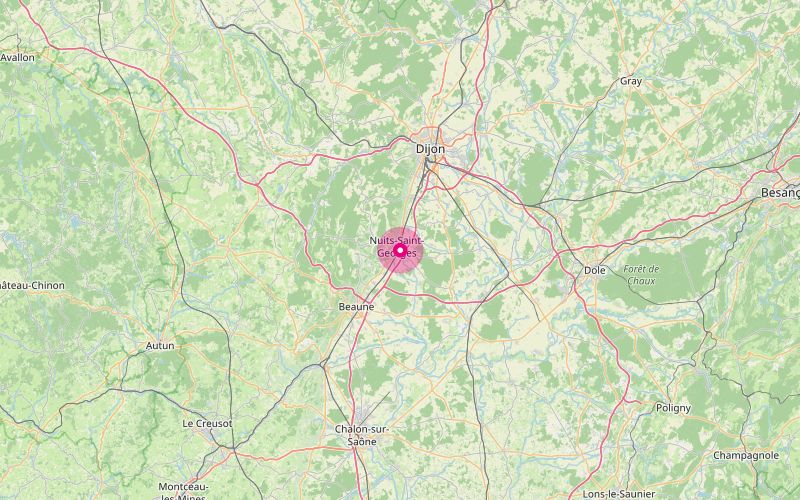
## Côte de Nuits at a glance The Côte de Nuits is the northern half of the Côte d’Or in Burgundy, between Marsannay to the north and Corgoloin to the south, along a narrow ribbon of slopes just over 20 kilometers long. The name refers to the winegrowing area structured around Nuits-Saint-Georges, but it also designates a communal regional appellation recognized in 1937 for red wines and, more marginally, white wines. The vineyard covers a little over 1,500 hectares when considering all the appellations in the sector, with a strong dominance of reds made from Pinot Noir. This is where the majority of Burgundy’s red grands crus are concentrated, which explains a worldwide renown out of all proportion to the area’s geographic narrowness.
## Terroir and geology The Côte de Nuits is a winegrowing escarpment set between the limestone edge of the Burgundian plateau and the Saône plain. The best parcels occupy moderate slopes, often on the lower to mid-slope, with mostly east to southeast exposures that favor steady ripening. This layout creates a succession of highly differentiated climats, sometimes separated by only a few meters, yet with noticeably different water and temperature behavior.
The geological substrate belongs mainly to the Jurassic, with an alternation of hard limestones, marls, and limestone scree. Soils are rarely deep in the most reputed sectors, which naturally limits vine vigor and encourages small, concentrated berries. Variations in texture, stoniness, and clay content explain a significant share of the stylistic differences between Gevrey-Chambertin, Morey-Saint-Denis, Chambolle-Musigny, Vosne-Romanée, and Nuits-Saint-Georges.
In Marsannay and Fixin, combinations of brown limestones, marls, and scree produce reds that are often direct, racy, and structured. In Gevrey-Chambertin, the mosaic is especially legible, between cool combes, stony slopes, and more clay-rich sectors, which contributes to the diversity of expressions within a single commune. Morey-Saint-Denis stands out for a geological continuity that can yield both wines of tension and wines of depth, depending on position on the slope.
Chambolle-Musigny rests in part on thin, stony, well-drained soils, often associated with more delicate textures and fine tannins. Vosne-Romanée, at the center of the Côte, brings together limestones, marls, and brown clays in a balance that favors wines of refined density rather than overtly tannic display. Farther south, Nuits-Saint-Georges shows a marked duality between the north of the appellation, often more velvety, and the south, frequently firmer and more earthy.
The notion of climat is central to understanding the Côte de Nuits. In Burgundy, a climat designates a precisely delimited parcel, long identified for its own distinct identity. This parcel-by-parcel reading, consolidated by centuries of observation and then by classification as grands crus and premiers crus, underpins the Côte’s qualitative hierarchy far more than any simple opposition between villages.
## Climate The climate is semi-continental with moderated oceanic influence, with cold winters, springs exposed to frost risk, and summers that can be hot without losing all nighttime freshness. The flowering period and véraison are sensitive to temperature swings, which makes each vintage especially legible in the style of the wines. Consistency is therefore not the sector’s primary characteristic; by contrast, the great terroirs often absorb extremes better than ordinary parcels.
The combes that cut into the slope play an important role in air circulation and in modulating temperatures. They can bring freshness and wind, slightly delay certain ripenings, and increase variability from one lieu-dit to another. This effect is particularly noticeable around Gevrey-Chambertin and Chambolle-Musigny, where one moves from a solar register to a more airy one over short distances.
Rainfall is not exceptionally high, but its distribution can be decisive. Storm episodes at the end of summer increase the risk of dilution, rot, or blocked ripening, especially for thin-skinned Pinot Noir. Dry years, by contrast, often give lower yields and more concentrated wines, provided the vine does not enter excessive water stress.
Climate change has already altered the balances of the Côte de Nuits. Harvest dates tend to come earlier, sugar ripeness is more easily achieved, and the question of preserving acidity becomes more sensitive in early-ripening sectors. In this context, relative altitude, exposure, harvest date, and the management of whole clusters or extraction in the cellar take on increased weight in the final style.
## Grape varieties The principal grape variety of the Côte de Nuits is very clearly Pinot Noir, which accounts for the overwhelming majority of red wines. Its ability to convey differences in soil and exposure explains the region’s historic importance in shaping the idea of terroir. Here it produces wines in which tannic grain matters as much as color, which is always less intense than in southern or oceanic regions.
Chardonnay is present in smaller proportion and is used to produce the sector’s rare whites, notably in certain communal and regional appellations. Pinot Blanc and Pinot Gris are also found incidentally within the traditional Burgundian framework, although their role remains marginal. Rules on grape composition and blending vary according to appellation, but reds may admit authorized accessory varieties in limited proportions, a practice now uncommon in benchmark cuvées.
The Côte de Nuits is also a land of massal selections and old clonal heritage, even if 20th-century replanting standardized part of the vineyard. Many domaines are now seeking plant material better suited to low yields, resistance to water stress, and fine tannin expression. High planting density remains a strong Burgundian hallmark, as it encourages competition between vines and limits production per vine.
## Wine styles The reds of the Côte de Nuits generally combine aromas of cherry, morello cherry, raspberry, fine blackberry, rose, violet, sweet spices, undergrowth, and, with age, delicate game, truffle, and dry leaves. Depending on villages and climats, the cursor shifts between limestone tension, flesh, tannic energy, and aromatic depth. Structure is never only a matter of power; in the best wines, it rests on precision, persistence, and quality of texture.
Marsannay and Fixin often produce wines that are straightforward, spicy, and firm in youth, with serious aging capacity in the best parcels. Gevrey-Chambertin frequently combines breadth, sap, and frame, but its grands crus can also show remarkable restraint before opening slowly. Morey-Saint-Denis often sits at the junction of density and straightness, while Chambolle-Musigny often favors fineness of grain, floral lift, and a lace-like impression.
Vosne-Romanée is sought after for its rare union of intensity and suavity, with textures often more enveloping than demonstrative. Nuits-Saint-Georges offers more earthy, more spicy profiles and sometimes stricter youthfulness, especially in the southern part of the appellation. This diversity explains why the Côte de Nuits cannot be reduced to a single stereotype of great Burgundian Pinot Noir.
Aging takes place mainly in oak barrels, with the share of new wood adjusted according to the rank of the appellation, the domaine’s style, and the concentration of the vintage. The best producers now seek less the imprint of wood than the refinement of tannins and the wine’s stability during élevage. The proportion of whole clusters, the duration of vatting, and the intensity of extraction matter at least as much as élevage in defining style.
The designations Bourgogne, village, premier cru, and grand cru structure the region’s qualitative reading. The grands crus of the Côte de Nuits notably include Chambertin, Chambertin-Clos de Bèze, Clos de Vougeot, Bonnes-Mares, Musigny, Echézeaux, Grands-Echézeaux, Richebourg, Romanée-Saint-Vivant, La Romanée, La Tâche, La Grande Rue, and Romanée-Conti. Aging potential ranges from a few years for accessible regional cuvées to several decades for premiers crus from great vintages and, even more so, for grands crus from the best producers.
## Producers to watch - Domaine Armand Rousseau: a leading reference in Gevrey-Chambertin, known for precise, deep wines rarely marked by fashion effects. - Domaine Trapet Père & Fils: an important player in Gevrey-Chambertin, with careful vineyard work and measured élevage. - Domaine Dujac: a signature name of Morey-Saint-Denis, reputed for its controlled use of whole clusters and wines closely followed by the market. - Domaine Comte Georges de Vogüé: a historic name in Chambolle-Musigny, essential for understanding Musigny and Bonnes-Mares. - Domaine de la Romanée-Conti: an emblematic domaine of Vosne-Romanée, playing a central role in the global image of Burgundy’s grands crus. - Domaine Henri Gouges: a pillar of Nuits-Saint-Georges, useful for grasping the depth and classical staying power of the sector.
## Food and wine pairings - Gevrey-Chambertin village or premier cru with roast pigeon: the wine’s density matches the bloody flesh without hardening the flavors. - Chambolle-Musigny with veal fillet and girolles: the fineness of the tannin and the floral register pair well with delicate textures. - Vosne-Romanée with truffled Bresse poultry: the pairing relies on aromatic depth rather than power. - Nuits-Saint-Georges with roast duck and reduced jus: the wine’s more earthy structure supports the richness of the meat. - Marsannay rouge with a game terrine: a relevant choice for a young, spicy, still-tonic wine. - A white from the Côte de Nuits with pike-perch in beurre blanc or a lightly aged Comté: the wine’s tension keeps the dish from becoming heavy.
## FAQ ### Where does the Côte de Nuits begin and end? The Côte de Nuits stretches across the northern Côte d’Or, from Marsannay to Corgoloin. It covers Burgundy’s most famous red wine communes, around Gevrey-Chambertin, Vosne-Romanée, and Nuits-Saint-Georges.
### Does the Côte de Nuits produce only red wines? No, but reds overwhelmingly dominate production. White wines do exist, mainly based on Chardonnay, without occupying the same historical or economic place as the reds.
### What is the difference between Côte de Nuits and Nuits-Saint-Georges? The Côte de Nuits refers to a broader geographic and winegrowing area. Nuits-Saint-Georges is a commune and a village appellation located in the southern part of that area.
### Which villages are the most renowned? Gevrey-Chambertin, Chambolle-Musigny, Vosne-Romanée, and Nuits-Saint-Georges are the names best known to the general public. Morey-Saint-Denis, Marsannay, and Fixin are also essential to understanding the stylistic continuity of the slope.
### Should a Côte de Nuits wine be decanted? It depends on the wine’s age, the vintage, and the level of the appellation. A young, structured wine may benefit from careful aeration, while an older, delicate wine is often served after simply opening the bottle in order to preserve its bouquet.