Cabardès, the AOP hinge between the Atlantic and the Mediterranean
To the west of Carcassonne, Cabardès brings together two families of grape varieties. This Languedoc AOP draws its identity from a regulated blend and a transitional climate.
geoVINUM · 2026-06-12
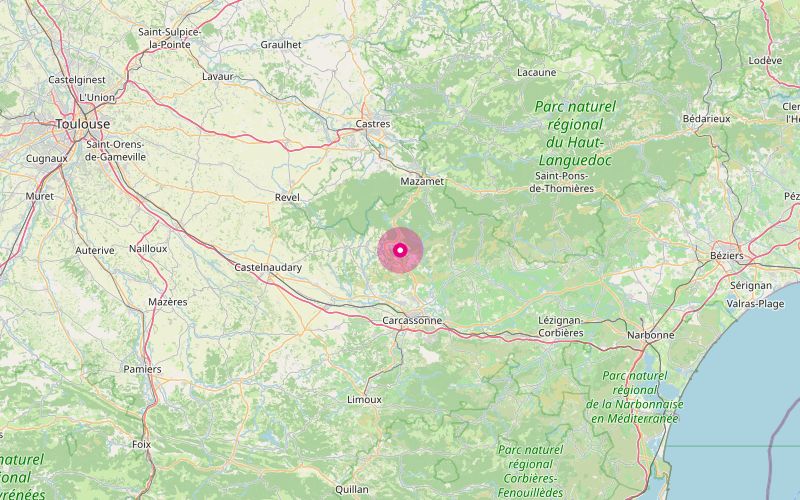
Cabardès at a glance
Cabardès is a protected designation of origin in the Languedoc, located northwest of Carcassonne, on the first rises that herald the Montagne Noire. The appellation was recognized as an AOC in 1999, after a period as VDQS, and was then incorporated into the European AOP framework. It produces red and rosé wines; whites are not included within the appellation area. The vineyard covers just over 500 hectares depending on the vintage, making it a small designation on the Languedoc scale.
Terroir and geology
The Cabardès vineyard stretches across an amphitheater of hillsides facing south to southeast, between the Carcassonne plain and the slopes of the Montagne Noire. This topographical position favors both sunshine and air circulation, two decisive factors for grape ripening and the sanitary condition of the harvest. The most sought-after plots occupy terraces and well-drained slopes, where the vine never benefits from excessive water supply. The topography thus gives wines that are generally tauter and more structured than those from the neighboring plain.
From a geological standpoint, Cabardès is not a uniform mosaic but a blend of formations resulting from the meeting of the ancient reliefs of the Montagne Noire and the more recent deposits of the Aquitaine Basin. One finds limestone, sandstone, marl, rolled pebbles, as well as iron-rich stony formations locally called rougets. Schist is not the central marker of the appellation; it may exist here and there in the regional environment, but it does not sum up the soil identity of Cabardès. What matters here above all is the diversity of the soils, their drainage capacity, and their ability to moderate vegetative vigor.
Limestone soils often bring acidic backbone, a certain tannic firmness, and a straighter reading of the fruit. More gravelly or stony sectors favor rapid warming in spring and steady ripening of late varieties, especially the cabernets. Marl and clay, when well exposed, contribute flesh and density to the blends. This variety of substrates allows growers to adapt grape varieties plot by plot, which is essential in an appellation founded on the complementarity of varieties.
Climate
Cabardès is often described as a transitional appellation, but the phrase only makes sense if the climatic mechanisms at work are specified. The vineyard receives a double influence: Atlantic through westerly flows that bring coolness and relative humidity, Mediterranean through sunshine, dry summers, and southern light. This meeting does not produce a bland compromise, but an alternation of regimes that directly shapes the style of the wines. Temperature swings, ventilation, and the spreading out of ripening are at the heart of the local identity.
Oceanic influence helps preserve a certain physiological freshness in the Bordeaux varieties, notably merlot and cabernet franc, which here can retain suppleness and a clear aromatic framework. Mediterranean influence, for its part, favors the proper ripening of syrah and grenache, with sunnier expressions of fruit and broader tannins. Wind plays an important role by limiting disease pressure and reducing humidity during sensitive periods. The proximity of the relief also introduces contrasts depending on altitude and exposure, with harvests sometimes noticeably staggered from one sector to another.
In the context of climate warming, this intermediate position is an asset but does not remove the need for vigilance. Drought episodes, heat spikes, and late-summer storm rains can complicate balances. Several estates are therefore adapting canopy management, harvest dates, and rootstock selection to preserve freshness in the blends. In Cabardès, the climate question is read less through the search for power than through the maintenance of credible tension and drinkability.
Grape varieties
Cabardès’s regulatory originality lies in its blending principle between two families of grape varieties. The so-called Atlantic varieties are cabernet-sauvignon, cabernet franc, and merlot. The so-called Mediterranean varieties are mainly syrah and grenache, to which cinsaut may be added depending on the case. This structure clearly sets the appellation apart within the Languedoc landscape, where specifications more often emphasize a classic Mediterranean hierarchy.
For red wines, the blend must combine these two groups, each representing a significant share of the wine. The rule generally retained is that at least 40% of the blend must come from Atlantic varieties and at least 40% from Mediterranean varieties. The remainder may be completed within the framework of authorized grapes, which leaves room for interpretation without calling into question the logic of the appellation. It is therefore not a simple coexistence of varieties, but a legal identity founded on balance.
In practice, cabernet-sauvignon brings structure, tannic backbone, and aging potential. Merlot often gives mid-palate volume and a more immediate expression of fruit, while cabernet franc contributes freshness, floral notes, and precision. On the Mediterranean side, syrah provides color, spice, and depth, while grenache contributes breadth, roundness, and a perception of sweetness. Cinsaut, when used, can lighten the framework and support aromatic brightness, especially in rosés.
Rosés follow the same identity logic, even if their expression is different. They are not anecdotal within the appellation, but Cabardès’s qualitative core and image remain largely associated with reds. Whites are not claimed under Cabardès, which clarifies the appellation’s message and concentrates the work on a limited number of styles.
Wine styles
Cabardès red is defined first and foremost by a balance between southern density and structural freshness. The best examples offer ripe black or red fruit, a spicy framework, sometimes discreet garrigue notes, and above all a straighter finish than in many reds from the southern Languedoc. The blend does not erase the place; rather, it acts as a revealer of the different ripeness profiles made possible by the local climate. The result can be supple and approachable in entry-level cuvées, or tighter and deeper in single-plot selections.
Élevage varies according to the producer, ranging from tank to foudre and barrel. The best estates use wood as a textural tool rather than as an aromatic signature. There is no qualitative necessity to mark these wines strongly with oak, because the personality of Cabardès rests more on the clarity of the blend and the quality of the fruit. Serious reds often benefit from a few years of waiting, especially in structured vintages where cabernet-sauvignon and syrah dominate the tannic impression.
Cabardès rosés are generally vinified to favor straightforward fruit, tension, and a firmer texture than in purely festive rosés. They may show nuances of small red berries, citrus, and sweet spices, with a dry, savory finish. These are table wines more than simple terrace wines. Their interest lies precisely in this ability to retain length without weighing down the palate.
In terms of aging, basic reds are very drinkable within three to five years for their fruit and suppleness. The most ambitious cuvées, from low yields and controlled élevage, can evolve favorably over eight to twelve years, sometimes longer in the best vintages. With time, they gain complexity in registers of blond tobacco, spice, undergrowth, and stewed fruit without losing all tension. Rosés are best drunk younger, generally within two years of the harvest.
Producers to watch
- Château de Pennautier: a historic player in the area, it has contributed greatly to the appellation’s visibility with consistent and educational cuvées.
- Domaine de Cazaban: an organically farmed estate, known for precise, lightly handled wines that read the diversity of Cabardès soils well.
- Domaine de l’Arjolle: a recognized Languedoc property, present in Cabardès with a reliable reading of blends between Atlantic and Mediterranean grape varieties.
- Château Salitis: a serious address in the appellation, attentive to cabernet ripeness and balanced élevage.
- Domaine Ventenac: a well-regarded producer for clean, accessible wines, useful for understanding the contemporary style of Cabardès.
- Domaine Le Clos du Marbrier: a small name appreciated by enthusiasts for characterful reds, without excess wood or concentration.
Food and wine pairings
- A red Cabardès with grilled rib steak works through structural affinity: the cabernet tannins answer the richness and syrah brings the spicy foundation.
- Roast duck breast, served with a light black-fruit reduction, highlights the southern side of the blend while respecting its freshness.
- A shoulder of lamb with herbs, slow-cooked, pairs well with riper cuvées where grenache and syrah broaden the palate.
- A cassoulet from Castelnaudary can suit the fleshiest Cabardès reds, provided overly marked woody élevage is avoided.
- The appellation’s rosés pair effectively with roasted vegetable dishes, a pissaladière, or marinated poultry skewers.
- With an uncooked pressed cheese, such as mountain tomme, a few-years-old red finds a convincing field of expression.
FAQ
Where exactly is the Cabardès appellation located?
Cabardès is located west and northwest of Carcassonne, in the Aude, on the foothills of the Montagne Noire. It belongs to the Languedoc by its administrative winegrowing framework, but its identity is marked by an Atlantic influence unusual in the region.
Why is Cabardès said to be a transitional appellation?
Because its climate and grape varieties combine two French references that are often opposed: Bordeaux for the Atlantic varieties, and the Mediterranean South for syrah and grenache. This dual belonging is not merely cultural; it is written into the blending specifications.
Does Cabardès produce only red wines?
No. The appellation produces reds and rosés. However, it does not claim white wines under the Cabardès appellation.
Can Cabardès wines age?
Yes, especially the best-built reds. Serious cuvées often combine the aging capacity of the cabernets with the tannic and aromatic ripeness of syrah, allowing for interesting development over several years.
What is the typical taste of a Cabardès?
A successful Cabardès combines ripe but not jammy fruit, present tannins without excessive hardness, and a fresher finish than in many Mediterranean reds. Aromas may mingle blackcurrant, blackberry, pepper, dried herbs, and sometimes a floral touch depending on the share of cabernet franc and the vintage conditions.