Bugey, the Ain PDO Between Hills, Bubbles, and Freshness
Between the Rhône, Jura, and the Savoyard foreland, Bugey produces a mosaic of still and sparkling wines. Cerdon, Montagnieu, and the local crus reveal all of its singular character.
geoVINUM · 2026-06-12
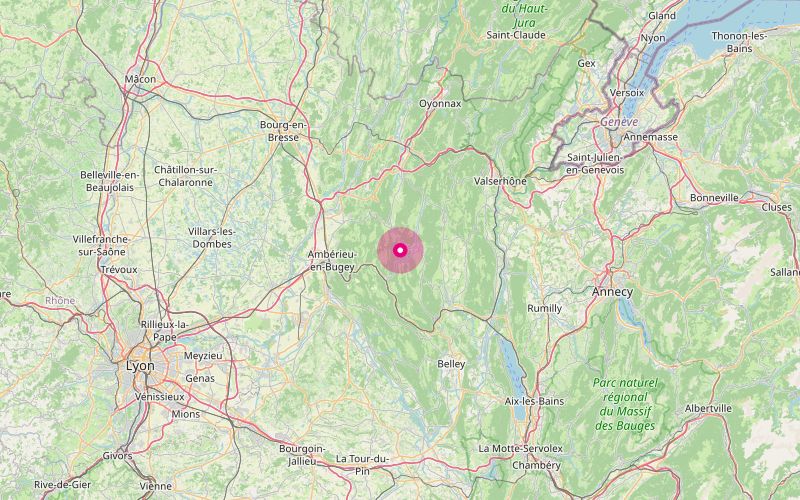
## Bugey at a Glance Bugey is a protected designation of origin in the Ain department in eastern France, set against the foothills of the southern Jura and opening toward the Rhône Valley. The Bugey appellation d’origine contrôlée was officially recognized in 2009, after a long history as a VDQS, while certain geographical denominations such as Cerdon and Montagnieu had already become well established in common usage. The vineyard produces white, red, rosé, and sparkling wines, with a particularly strong identity in sparkling styles. Its total area remains modest by French standards, which explains limited production and still uneven distribution beyond its home region.
## Terroir and Geology The Bugey vineyard is not a single continuous block, but rather a patchwork of scattered sectors between the southern Jura massif, the limestone folds of Bugey, and the transitional zones toward Savoie and the Rhône. This geographic fragmentation explains the wide variety of exposures, elevations, and soils, and thus a more marked heterogeneity than in more compact wine regions. The vines are often planted on slopes, sometimes steep ones, where mechanization remains limited. This topography contributes both to the potential quality of the grapes and to the high cost of vineyard work.
The geological base is largely limestone, with marl, scree, glacial moraines, and clay-limestone formations depending on the sector. Well-drained soils are particularly well suited to white grape varieties and the production of sparkling wines, because they encourage slow ripening while preserving acidity. In more clay-rich or deeper soils, the reds gain more structure and consistency. This soil diversity rules out quick generalizations: one must think village by village, and sometimes even slope by slope.
Cerdon, probably the best-known name among the general public, lies on steep hillsides around the Cerdon Valley and benefits from a cool environment favorable to the méthode ancestrale. Montagnieu, another major center, has established itself as a land of more structured sparkling wines, notably from chardonnay and altesse. Other communes broaden the appellation’s range with still whites, light- to medium-bodied reds, and a few gastronomic rosés. Bugey is therefore understood less as a single absolute stylistic unit than as a coherent mosaic of cool-climate terroirs.
## Climate The climate of Bugey is semi-continental, with clear mountain influences, locally tempered by more moderate Rhône effects. Winters can be severe, and spring often exposes the vines to frost risk, especially in valley bottoms. Summer is generally moderate rather than truly hot, which delays harvest compared with more southerly areas. This relative coolness is one of the essential drivers of the wines’ balance.
Temperature swings and altitude help preserve acidity, a key point for sparkling wines and dry whites. In cooler vintages, phenolic ripeness in the reds can become an issue, especially for later-ripening varieties or on less favored parcels. Conversely, warmer years produce fuller wines without entirely erasing the acidic backbone that characterizes the area. Climate change has generally improved the regularity of ripening in some cases, while also raising new questions about preserving the original tension of these styles.
Rainfall is fairly abundant and requires constant sanitary vigilance, especially since fungal pressure can be heightened by the terrain and irregular air circulation. Exposure plays a decisive role here: a well-ventilated slope does not face the same constraints as a more enclosed parcel. This fine reading of microclimate shapes both grape variety choices and harvest dates. It also explains why the best producers in Bugey rely on very precise parcel-level knowledge.
## Grape Varieties The grape mix in Bugey reflects its position at the crossroads of Burgundian, Jura, Savoyard, and Rhône influences. In whites, chardonnay holds an important place, both for still wines and for certain sparkling wines. Jacquère, altesse—often called roussette—and mondeuse blanche complete the regional range, while molette is used notably in some sparkling wines. This diversity gives the appellation an uncommon freedom of expression for a vineyard of modest size.
For reds and rosés, gamay occupies a major place, often with convincing results in a juicy, digestible, and lively register. Pinot noir is also permitted and can produce finer wines, sometimes lightly spicy, with moderate body. Mondeuse noire brings a more Savoyard tone, with a peppery, deeply colored, and structured profile when ripeness is achieved. Depending on the sector, blends or single-varietal vinifications may be favored, further reinforcing the variety of expressions.
The case of Cerdon deserves special mention, because its identity rests on a clearly defined pair of grape varieties: gamay and poulsard, also called ploussard. The wine is made according to the méthode ancestrale, with the sparkle created from naturally present sugars and yeasts, without dosage comparable to the classic framework of traditional sparkling wines. This approach gives rise to wines that are low in alcohol, fruity, and slightly sweet. Cerdon should therefore not be read as simply a rosé sparkling wine, but as a historic style in its own right.
## Wine Styles Bugey’s still whites are often the appellation’s most underestimated wines. Chardonnay-based versions can combine moderate flesh, notes of citrus and white fruit, and a saline or chalky finish depending on the terroir. Cuvées made from altesse gain aromatic lift, with floral, aniseed, or stone-fruit nuances, sometimes suitable for a few years of cellaring. Oak aging does exist, but the most accurate interpretations are generally those that preserve fruit clarity and native freshness.
The reds sit in a medium-intensity register, more oriented toward balance than power. Gamay yields supple, lively wines very well suited to the table; pinot noir aims for delicacy; mondeuse brings backbone and a more marked spicy tone. Long, heavily wooded élevage is not at the heart of the local style. The best examples benefit instead from preserving their energy, aromatic definition, and measured extraction.
Rosés remain confidential but can be highly relevant, especially from gamay, with a dry, taut, food-friendly profile. They find their appeal in a climate where natural acidity remains a technical and sensory asset. Their style is far from anecdotal when handled with precision. They fit into Bugey’s overall logic: fresh-leaning wines without excess weight, designed to accompany a meal.
Bugey’s most visible identity, however, remains that of its sparkling wines. In Montagnieu, sparkling wines made by the traditional method offer more vinous and structured profiles, with generally fine bubbles and a chardonnay base, complemented as the case may be by other permitted varieties. Cerdon, made by the méthode ancestrale, speaks an entirely different language: pink color, low alcohol, immediate fruit, perceptible sweetness, and delicate mousse. These two poles show that within a single appellation, sparkling wine can take very different forms without losing its territorial coherence.
As for aging potential, the styles must be clearly distinguished. Cerdon is intended for fairly youthful drinking, to preserve the brilliance of the fruit and the spontaneity of the mousse. Sparkling wines from Montagnieu and certain site-driven whites can evolve favorably for several years, gaining complexity without losing all their tension. The reds, depending on variety and vintage, often drink well between three and eight years, with a few more ambitious exceptions from the best parcels.
## Producers to Watch - Renardat-Fache: a historic Cerdon reference, with precise cuvées that clearly illustrate the balance between fruit, sweetness, and freshness. - Maison Angelot: an important player in the vineyard, consistent in both sparkling and still wines, with an accessible reading of the appellation. - Domaine Monin: a serious estate for understanding the diversity of Bugey, notably through Cerdon and several still expressions. - Yves Duport: a producer recognized for precise wines, capable of showing the potential of both whites and sparkling wines. - Caveau Bugiste: a benchmark cooperative, useful for taking the measure of Bugey’s stylistic range through different cuvées. - Domaine Trichon: an established name in the appellation, appreciated for frank wines faithful to their origin.
## Food and Wine Pairings - Cerdon du Bugey with a raspberry tart: the pairing works through aromatic continuity and through the contrast between the light mousse and the texture of the dessert. - Chardonnay-based Bugey blanc with féra or char fillets: the wine’s tension supports the fish’s delicate flesh without dominating the dish. - Roussette du Bugey with chicken in cream and morels: altesse brings enough lift to accompany a rich sauce while retaining length. - Gamay-based Bugey rouge with charcuterie from Ain or pâté en croûte: the vivid fruit and moderate tannins work well with fatty, salty textures. - Mondeuse du Bugey with a herb-crusted rack of lamb: the variety’s peppery character usefully echoes the herbal notes and the flavor of the meat. - Sparkling Montagnieu with gougères or young Comté: the bubbles and acidity cleanse the palate, while the wine’s substance stands up to the cheese.
## FAQ ### Where exactly is the Bugey vineyard located? Bugey is located in the Ain department, between the foothills of the southern Jura and the routes leading toward Savoie and the Rhône Valley. The vineyard is fragmented into several sectors, which explains its diversity.
### What is the difference between Bugey and Cerdon du Bugey? Bugey is the general appellation, covering several colors and styles. Cerdon is a geographical denomination specializing in a sparkling rosé wine made according to the méthode ancestrale.
### Does Bugey mainly produce sparkling wines? Yes, sparkling wines are the appellation’s most visible claim to fame, especially through Cerdon and Montagnieu. That should not overshadow the real interest of certain still whites and light- to medium-bodied reds.
### What are the most important grape varieties in Bugey? Chardonnay, gamay, and pinot noir are among the most widely planted varieties. To these must be added more regional grapes such as altesse, jacquère, mondeuse noire, mondeuse blanche, molette, and, for Cerdon, poulsard.
### Do Bugey wines age well? Most cuvées are intended to be approachable relatively early, especially rosés and Cerdon. Certain whites, some traditional-method sparkling wines, and the more serious reds can nonetheless evolve favorably over several years.