Beaune, a Village Appellation at the Heart of the Côte
Beyond its reputation as the capital of Burgundy wines, Beaune produces mostly reds and rarer whites, drawn from a finely detailed patchwork of climats.
geoVINUM · 2026-11-03
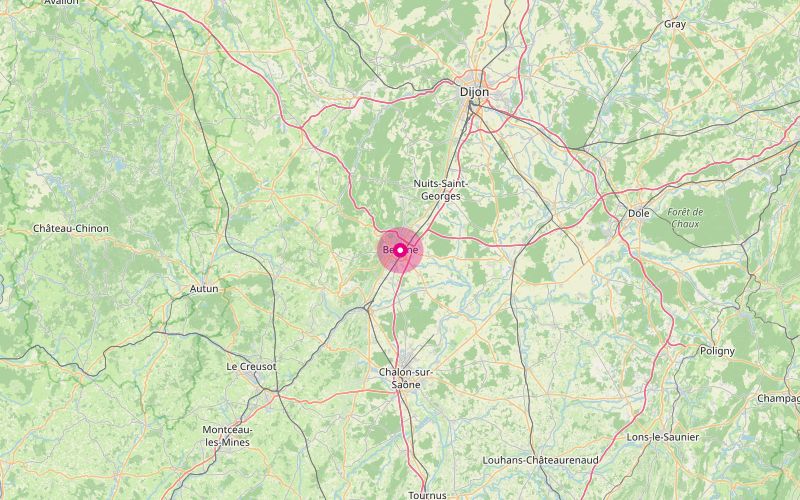
## Beaune at a Glance Beaune is a village appellation in the Côte de Beaune, in Côte-d’Or, at the heart of wine-growing Burgundy. The appellation d’origine contrôlée dates back to 1936 and covers both red and white wines, with a clear majority of reds made from pinot noir. Its vineyard extends over several hundred hectares, almost entirely within the boundaries of the commune of Beaune, and includes a significant number of climats classified as premier cru. Beaune is also a historic center of Burgundy wine trading, which helps give its name visibility far beyond the volume it alone produces.
## Terroir and Geology Beaune occupies a central position on the slope of the Côte de Beaune, between Savigny-lès-Beaune to the north and Pommard to the south. The vineyard rises from the foot of the slope up to the best-exposed mid-slope sectors, with a mosaic of parcels whose altitude, gradient, and aspect strongly shape the style of the wines. This diversity explains why it is difficult to reduce Beaune to a single expression, despite its clearly recognizable communal identity.
The substratum is dominated by the classic Jurassic formations of the Burgundian côte, with limestone and marl alternating according to the contour of the relief. The mid-slope sectors, often the most sought-after, rest on stony, well-draining soils where the vine roots into shallow layers favorable to concentration. Lower down the slope, the soils become more clay-rich and richer in colluvium, generally yielding wines that are softer and more immediately approachable in youth.
The notion of climat comes fully into its own in Beaune. The premier crus are spread across the appellation’s two usual main slopes, to the north toward Savigny and to the west-southwest above the town, with signatures that can be quite distinct. Les Bressandes, Grèves, Teurons, Clos des Mouches, Marconnets, Cent Vignes, and Sizies do not tell the same story, even when they belong to the same commune and the same grape variety.
Reds from the leanest, stoniest soils often gain in tension, fruit precision, and tannic finesse. More clay-rich parcels provide greater flesh and a more earthy volume, sometimes with a darker register. As for the whites, less numerous but very much present, well-exposed limestone zones favor precise and nuanced expressions in which élevage should not mask the wine’s natural relief.
## Climate Beaune has a semi-continental climate with moderate oceanic influence, following Burgundy’s classic pattern. Winters are cold, springs may be marked by frost risk, and summers alternate between dry periods and stormy episodes. Grape ripeness therefore depends on a delicate balance between heat accumulation, water availability, and harvest date.
The côte plays an important protective role by providing good morning sunshine and relative ventilation on the slopes. This exposure partly limits stagnant humidity, without eliminating the risk of fungal diseases in rainy vintages. The regularity of ripening varies noticeably depending on parcel position, which reinforces the importance of precision viticulture and sorting at harvest.
In cool vintages, Beaune can produce wines that are taut, fragrant, and structured, with clear acidity and sometimes firm tannins in the reds. In warmer years, the commune often retains an appreciable ability to preserve balance, especially on the well-drained hillside sectors. This capacity to absorb climatic variation partly explains the qualitative consistency of the appellation’s best names.
Recent climate change has nevertheless shifted certain reference points. Harvest dates have generally moved earlier, and the question of managing phenolic ripeness, alcohol, and freshness has become central in both viticultural and winemaking choices. In Beaune as elsewhere in Côte d’Or, the challenge is no longer simply to achieve ripeness, but to calibrate it without losing the legibility of place.
## Grape Varieties Pinot noir is the main grape variety for Beaune reds and by far the most widely planted in the appellation. It expresses a broad range here, from supple, floral profiles in village-level cuvées to deeper, more structured premier crus suited to aging. The quality of the tannin, more than color alone or power, remains one of the most useful markers for judging the level of a Beaune red.
For the whites, chardonnay clearly dominates. The original article referred to official recognition in 2011 for a supposedly distinct white appellation, but that wording is inaccurate: Beaune is a long-established village appellation, authorized for both red and white wines under its original decree. Beaune white wines therefore do not belong to a separate appellation created recently, but to a historically minor production within the same communal AOC.
Accessory grape varieties authorized in the Burgundy area do exist from a regulatory standpoint, but today they play a marginal role in Beaune. In practice, the reds are made from pinot noir and the whites from chardonnay, both for reasons of custom and stylistic coherence. Pinot blanc may survive residually in some old Burgundian plantings, but it does not shape the appellation’s contemporary identity.
In Beaune, the logic of blending is less one of varietal blending than of parcel blending or vinification climat by climat. Many producers vinify their premier crus separately, and sometimes even certain village parcels, in order to preserve differences in soil and exposure. This fine-grained reading of the vineyard is essential to understanding the appellation’s internal hierarchy.
## Wine Styles Beaune reds are the appellation’s most common face. They generally stand out for their clear red fruit, frequent floral notes, body ranging from medium to fairly full depending on the climat of origin, and a more serious structure than one might sometimes imagine. The best premier crus combine sap, depth, and length, with a tannin texture that can become highly refined after a few years in bottle.
At the communal level, the reds are often more quickly accessible than those of Pommard or Aloxe-Corton, without giving up complexity. Premier crus located in reputed sectors may nevertheless require time to come together, especially in concentrated vintages. A cellaring window of a few years suits many village cuvées, while ambitious premier crus can last distinctly longer when balance is in place.
Beaune whites are more confidential but deserve attention. They generally show a profile that is more understated than demonstrative, with notes of ripe citrus, apple, white flowers, and sometimes hazelnut or fresh butter depending on élevage. Their interest often lies in a combination of measured flesh and limestone tension, far from overly oaky or overly broad expressions.
Oak élevage is common, especially among producers seeking a classic Burgundian expression, but its intensity varies widely. The best estates avoid overemphasizing the wine with too much new oak and instead seek textural support, slow micro-oxygenation, and better aging capacity. The most important designations to know are the communal-level Beaune and the many Beaune Premier Cru wines, with the climat name sometimes indicated on its own or as part of a blend of premier crus depending on the estate’s practices.
Clos des Mouches occupies a special place in the appellation’s imaginary, because this premier cru produces sought-after reds and whites. Other premier crus, such as Grèves and Bressandes, rank among the regular benchmarks for reds. This richness of climats makes Beaune as much an appellation for study as an appellation for drinking.
## Producers to Follow - Domaine des Croix: a precise and often very readable interpretation of Beaune’s climats, with reds that are both fine and structured. - Domaine de Montille: a taut style, not heavily marked by élevage, particularly useful for understanding the framework of the commune’s premier crus. - Bouchard Père & Fils: a historic Beaune player, owner of several major parcels, notably in Clos des Mouches. - Maison Joseph Drouhin: an essential reference for Clos des Mouches, in both red and white, with an elegant and consistent signature. - Domaine Chanson: a long-standing presence in Beaune and solid command of a wide range of the commune’s premier crus. - Domaine Albert Morot: a longstanding Beaune house, recognized for serious and classic interpretations of several local climats.
## Food and Wine Pairings Beaune reds call for cuisine built more on texture than on power. Their moderate structure, freshness, and aromatic expression make them versatile at the table, especially when one favors precise cooking and sauces that are not too sweet. The whites pair well with dishes whose substance responds to their élevage without overwhelming their tension.
- Beaune red and roast poultry: a Bresse chicken or roast guinea fowl pairs well with supple, floral village reds.
- Beaune Premier Cru red and duck: a medium-rare duck breast, served with a lightly marked reduction, suits denser, spicier cuvées.
- Beaune red and veal with mushrooms: the pairing works through earthy resonance, especially with premier crus that have already softened.
- Beaune white and pike-perch with beurre blanc sauce: the fish’s delicate flesh and the sauce’s measured richness highlight the wine’s tension.
- Beaune white and poultry in cream sauce: a Beaune chardonnay raised with restraint supports a poultry blanquette or cream-finished chicken supremes well.
- Beaune white and Burgundy cheeses: a lightly aged Cîteaux or a lightly salted Brillat-Savarin helps preserve the wine’s finesse.
## FAQ ### Does Beaune produce mostly white wine? No. Beaune is прежде всего a red-wine appellation based on pinot noir, with whites remaining a minority both in vineyard area and in volume. The renown of certain premier cru whites should not obscure this structural reality.
### Does the Beaune white appellation date from 2011? No. The Beaune appellation is old and has been recognized since 1936 as a communal AOC for both red and white wines. There is no distinct white appellation created in 2011 for Beaune.
### Which are the best-known premier crus of Beaune? Clos des Mouches, Grèves, Bressandes, Teurons, Marconnets, and Cent Vignes are among the names most often cited. Each nevertheless has its own profile, linked to its position on the slope and the nature of its soils.
### Are Beaune reds drunk young? Many communal-level cuvées can be approached relatively early if the vintage is supple and the élevage restrained. More ambitious premier crus often benefit from waiting a few years so that tannin and oak can integrate.
### How does Beaune compare with Pommard or Volnay? Beaune generally offers a broader and more heterogeneous spectrum, with reds often less austere than some Pommard and less strictly airy than some Volnay. It is an appellation of nuance, where the climat and the hand of the producer weigh particularly heavily in the final style.