Béarn, a Pyrenean vineyard between tradition and precision
At the foot of the Pyrenees, the Béarn PDO upholds a South-West vineyard with precise historical and technical contours, divided among reds, rosés, and whites.
geoVINUM · 2026-11-03
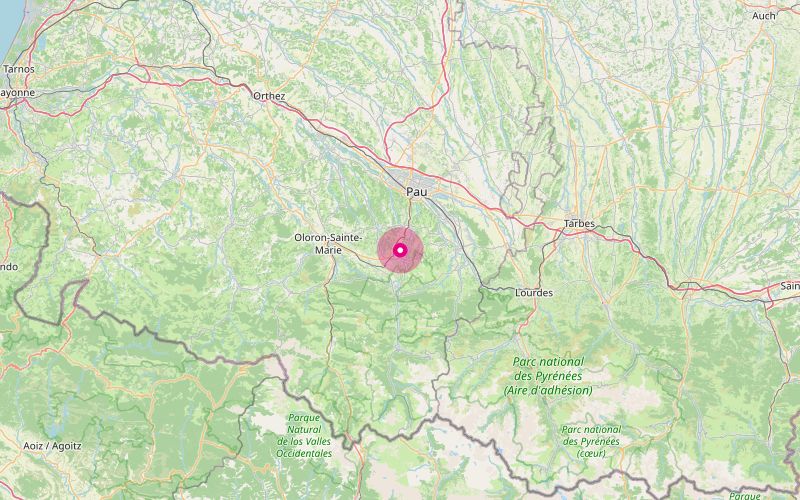
## Béarn in brief The Béarn protected designation of origin belongs to the Pyrenean foothills, in the South-West, around a vineyard spread across the Pyrénées-Atlantiques, the Hautes-Pyrénées, and a strip of the Gers. The appellation was first recognized as an appellation d'origine contrôlée in 1975, before moving into the European PDO framework; the date 2017 does not correspond to its birth. Béarn produces red, rosé, and white wines, with an additional geographical indication, Béarn Bellocq, reserved for reds and rosés. Volumes and planted area vary from one vintage to another; they remain modest on the French scale, confirming the confidential nature of this appellation.
## Terroir and geology The Béarn vineyard does not form a continuous block. It stretches across several sectors of the foothills, on slopes, terraces, and flatter benches whose topography largely determines where the vines are planted. This fragmentation explains the diversity of expressions, but also a shared identity linked to the proximity of the Pyrenees and the influence of the gaves.
The soils combine rolled pebbles, gravel, clays, and silts derived from alluvial and fluvioglacial deposits. On certain hillsides, marls and limestones also appear, with locally varying combinations depending on the basin and exposure. This soil mosaic encourages a parcel-based viticulture, where the choice of rootstock, planting density, and harvest date has a direct impact on the balance of the wine.
In the Bellocq area, often considered the most clearly identified core of the appellation, vines are established on terraces of the gave de Pau and on stony, well-drained soils. These materials store heat and contribute to good ripening of the red varieties. Elsewhere, more clay-rich or cooler soils support the tension of the whites and preserve acidity in the rosés.
The relief is nothing spectacular in the alpine sense, but it imposes real constraints. South- and south-east-facing exposures are sought after to secure ripening, while the coldest or dampest zones require rigorous vineyard management. In this context, the notion of terroir in Béarn rests less on a single signature than on the fine match between grape variety, soil, and microclimate.
## Climate Béarn’s climate falls under an oceanic regime with Pyrenean influence. Moist air masses coming from the Atlantic bring regular rainfall, while the proximity of the mountains accentuates certain thermal contrasts and occasional foehn effects. This combination sets Béarn apart from other South-West vineyards that are more straightforwardly Atlantic or more continental.
Winters are generally mild, but spring can expose certain parcels to the risk of frost depending on altitude and the shape of the terrain. Summer is temperate rather than scorching, with sometimes cool nights that favor the preservation of acidity and aromatic precision. The late season plays a decisive role, especially for late-ripening white varieties that need time to reach maturity without losing their nervous energy.
Pressure from fungal diseases remains a constant issue. Regular rainfall requires close monitoring of downy mildew, powdery mildew, and botrytis, particularly in the most enclosed or vigorous sectors. Vineyard practices, canopy management, and bunch aeration are therefore decisive in maintaining the sanitary condition of the grapes.
This climate does not produce wines of solar demonstration. Rather, it favors profiles marked by freshness, drinkability, and balanced ripeness. In the best vintages, this climatic moderation makes it possible to obtain precise reds, lively rosés, and structured whites without heaviness.
## Grape varieties The grape mix of Béarn reflects the history of the Gascon and Béarnais foothills. For reds and rosés, the central varieties are tannat, cabernet franc, and cabernet sauvignon. Tannat brings structure, color, and aging potential, while the cabernets contribute a more floral, spicier, or more cassis-driven register depending on terroir and ripeness.
Accessory varieties may complement these blends according to the specifications, but the style of the appellation clearly rests on this trio. In Bellocq, tannat occupies a particularly important place, which explains the firmness of the reds and their ability to gain harmony with a few years in bottle. Rosés, for their part, benefit from more measured extraction and from pressing or saignée adapted to the vintage.
For whites, the grape mix primarily combines gros manseng and petit manseng. Raffiat de Moncade, a local variety long marginalized, is indeed part of Béarn’s ampelographic heritage and contributes to the originality of certain cuvées. Other traditional varieties are also permitted, notably courbu, petit courbu, and camaralet de Lasseube, which contribute more to complexity than to volume.
It is worth correcting a widespread idea, however: Béarn is not an appellation of whites built exclusively on rare varieties. The mansengs form the backbone of the white wines, and the heritage varieties often play a supporting role in blends. The precise proportion rules may vary depending on color and wine type, but the spirit of the appellation favors blending in order to balance acidity, richness, and aromatic expression.
## Wine styles Béarn reds are generally deeply colored, firm in youth, and built on a serious tannic framework without seeking excessive concentration. Tannat often imposes dense substance, but the cabernets avoid rusticity when the grapes are harvested at proper ripeness. Aromas evoke black fruits, blackberry, plum, sometimes pepper, licorice, and, with development, notes of undergrowth.
Rosés hold a historic place in the appellation and should not be considered a mere by-product of the reds. They most often offer a deep color, a fresh yet fleshy palate, and flavors of small red berries, citrus, and sweet spices. They pair well at the table thanks to their relief and to a structure superior to that of many apéritif rosés.
The still whites combine tension, ripeness, and texture. Gros manseng brings volume and expressive fruit, petit manseng adds energy and persistence, while the more confidential varieties can introduce nuances of fine herbs, spice, or white flowers. Notes of white-fleshed fruit, citrus, quince, and sometimes a slight welcome bitterness on the finish are frequently found, making them well suited to gastronomy.
Maturation varies from one estate to another. Stainless steel dominates in order to preserve fruit clarity, but some producers use lees aging, or even a discreet proportion of wood on the most ambitious cuvées. The goal is not to mask the wine, but to give it more foundation and better bottle performance.
Aging potential depends strongly on color and producer. Rosés are meant to be drunk young, although the more serious cuvées can handle two or three years. The best whites can gain complexity over a few years, and reds based on tannat, especially in the highest-quality sectors, evolve favorably over five to ten years, sometimes longer in strong vintages.
## Producers to watch - Cave de Crouseilles: a major player in the Pyrenean foothills, useful for understanding the expression of South-West grape varieties and the modern reading of tannat. - Domaine Bru-Baché: a benchmark in Madiran and Pacherenc, with precise work that sheds light on the terroir and varietal affinities with neighboring Béarn. - Château de Rousse: an estate recognized for its foothill wines, relevant for appreciating the possible finesse of mansengs and structured reds. - Domaine Capmartin: a serious producer in the area, interesting for its measured use of élevage and palate balance. - Clos Lapeyre: a well-regarded address in Jurançon, useful for grasping the register of Béarnais white varieties and their potential for tension. - Domaine Montesquiou: a name to follow in the local landscape for an attentive interpretation of the terroirs of the Pyrenean South-West.
## Food and wine pairings - A Béarn rosé with a lightly rich Béarnaise garbure works well, as the wine supports the dish without weighing it down. - A Béarn white with Pyrenean trout and herbs highlights both the freshness of the fish and the tension of the wine. - A Béarn red pairs effectively with grilled duck breast, especially if the cooking preserves the juices and the seasoning remains simple. - A white aged on lees pairs well with brebis des Pyrénées, whose fat and salinity echo the wine’s structure. - A structured rosé suits a lightly spiced piperade, thanks to its fruit and substance. - A red dominated by tannat finds an excellent place alongside black pork confit or a short-braised stew, where the tannic framework is absorbed by the texture of the dish.
## FAQ ### Where exactly is the Béarn appellation located? The appellation is located in the Pyrenean foothills, mainly in the Pyrénées-Atlantiques, with extensions into the Hautes-Pyrénées and the Gers. It belongs to the broader South-West wine region, close to Jurançon, Madiran, and Pacherenc-du-Vic-Bilh.
### Does Béarn mainly produce white wine? No. The appellation produces reds, rosés, and whites, with a notable tradition of rosés and a significant presence of reds in the Bellocq zone. Whites are very much present, but they do not sum up the identity of the appellation.
### Since when has Béarn been an appellation? Béarn was recognized as an AOC in 1975. The European framework later generalized the use of the term PDO, but this does not correspond to a recent creation of the appellation.
### What are the emblematic grape varieties of Béarn? For reds and rosés, the key varieties are tannat, cabernet franc, and cabernet sauvignon. For whites, the mansengs dominate, complemented by traditional varieties such as raffiat de Moncade, courbu, petit courbu, or camaralet.
### Do Béarn wines age well? Rosés are intended for fairly prompt consumption. The best whites can evolve favorably over a few years, while the more serious reds, especially when tannat is fully ripe, have genuine aging potential.