Auxey-Duresses, Burgundy in Subtle Relief
Between Meursault and Monthélie, Auxey-Duresses crafts taut whites and hillside reds in an appellation where topography, freshness, and limestone matter just as much as reputation.
geoVINUM · 2026-11-03
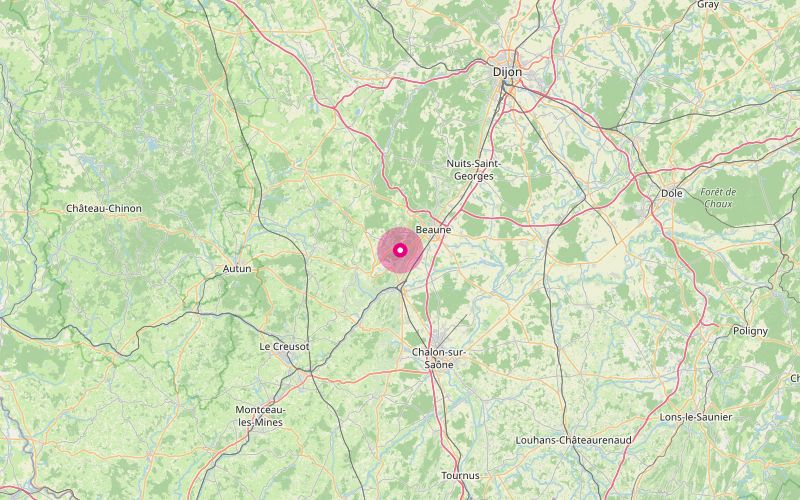
## Auxey-Duresses at a glance Auxey-Duresses is a communal appellation in the Côte de Beaune, in Burgundy, located in the valley that rises west of Meursault, between Monthélie and Saint-Romain. The appellation d’origine contrôlée was officially recognized in 1937 and covers both white and red wines, with several climats classified as premier cru. The vineyard area is divided between the village of Auxey-Duresses and the hamlet of Mélin, on terrain that is more enclosed and cooler than that of the neighboring lowland communes. In practice, the appellation is best known among enthusiasts for its Chardonnay whites with a taut profile, but its Pinot Noir reds also hold an important and long-standing place.
## Terroir and geology Auxey-Duresses occupies a side valley that opens onto Meursault, giving it a distinctive topographical identity within the Côte de Beaune. The relief is more pronounced, the slopes are sometimes steeper, and exposures vary depending on whether one is on the sides of the main valley or on the better-oriented shelves facing east and southeast. This configuration explains why ripening is often slightly later than in the sunniest sectors of Meursault.
The geological base belongs to the classic Jurassic formation of the Côte, with limestone and marl predominating. The soils often combine limestone scree, shallow brown soils, and more substantial clay pockets at the bottom of the slope. This heterogeneity directly shapes the style of the wines: the stoniest areas favor tension and precision, while the more clay-rich sectors bring greater flesh and volume.
The premiers crus are spread across several climats, including Les Duresses, Climat du Val, Clos du Val, Les Grands Champs, Les Bréterins, Les Ecussaux, Reugne, and Bas des Duresses. As is often the case in Burgundy, these names cover nuanced soil and topographical situations. The result is a range of expressions, from more chiseled whites to more structured reds, without losing the common thread of hillside freshness.
Compared with Meursault, Auxey-Duresses generally shows less opulence and more drive. Compared with Monthélie, the appellation can display a slightly firmer limestone backbone, especially in white. This is not a terroir of immediate showmanship, but a vineyard of detail, where the reading of place becomes clearer as élevage grows more restrained.
## Climate The climate is the semi-continental Burgundian type, with cold winters, springs exposed to frost risk, and summers that can be warm without erasing the moderating effect of the valley. The relative altitude and the partial enclosure of certain parcels maintain temperature variations that help preserve acidity. This structural freshness contributes strongly to the identity of the appellation’s wines.
Air circulation in the valley can slightly delay budbreak or curb certain forms of over-ripening, which is an advantage in sunny vintages. In return, the pressure of spring frost and, depending on the year, hail or humidity at flowering should not be underestimated. Auxey-Duresses therefore remains an appellation where consistency in quality depends greatly on vineyard management and sorting.
Climate change has increased average grape ripeness, including in this historically cooler sector. The whites gain density more easily, and the reds achieve satisfactory phenolic ripeness more regularly. The challenge today is no longer simply to bring the grapes to ripeness, but to preserve the outline of the terroir through precise harvest dates, measured extraction, and élevage that does not blur the wines’ natural salinity.
## Grape varieties For whites, the main grape variety is Chardonnay. The appellation rules also authorize Pinot Blanc, which appears occasionally in the Burgundian landscape, often as a complement or in old massal selections, but it remains very much a minority in Auxey-Duresses. In practice, the whites marketed under the appellation are overwhelmingly, if not almost exclusively, made from Chardonnay.
For reds, the main grape variety is Pinot Noir. As in several Burgundy appellations, accessory grapes historically permitted by the specifications may exist marginally, but they now play a negligible role in the actual vineyard plantings and in the final taste of the wines. The red identity of Auxey-Duresses clearly rests on hillside Pinot Noir.
Burgundian rules favor the expression of a principal grape variety in close connection with place. Auxey-Duresses is therefore not defined by blending in the Bordeaux or Rhône sense, but by parcel-based reading and the grape’s ability to translate slope, soil, and exposure. This is essential to understanding why stylistic differences between climats and between producers can be marked without departing from the framework of the appellation.
## Wine styles The whites of Auxey-Duresses stand out for a body that is straighter than broad, with an often clear acid framework and a limestone expression suggesting damp chalk, rubbed stone, white flowers, fresh apple, citrus, and sometimes a discreet hazelnut note with age. This is not the register of the creamy power of certain Meursaults, even if some more generously raised cuvées can gain breadth. The finest version of the local style rests on the balance between palate density, tactile freshness, and a saline finish.
The reds generally show cherry, raspberry, or redcurrant fruit, with notes of peony, sweet spices, and undergrowth as they evolve. Their tannic structure is in principle finer than massive, but the relief and certain more clay-rich soils can produce serious wines, especially in premier cru. Here again, purity of fruit and palate tension matter more than any pursuit of extraction or oaky dressing.
Oak élevage is common for both colors, in keeping with Côte de Beaune practice, but its proportion varies greatly from one estate to another. The most convincing producers today seek to limit the imprint of new oak in order to let the wine’s energy speak. In whites, overly assertive oak tends to blur the incisive character of Auxey-Duresses; in reds, it can harden tannins that are better kept precise.
Premier cru designations are important to follow, as they often provide an extra degree of depth and length. That said, a good village wine from a well-sited parcel can offer a very faithful reading of the appellation. In terms of aging, the whites drink well young for their brightness, but the best readily keep for several years; the reds, depending on the vintage and cru, often benefit from time for their tannic relief to soften.
## Producers to watch - Domaine d’Auvenay: highly sought-after signatures of extreme precision, which have helped put Auxey-Duresses back on the map of great terroirs followed by collectors. - Comte Armand: the estate owns vines in Auxey-Duresses farmed to a high standard, in a restrained and structured style. - Domaine Lafouge: a historic player in the village, consistent and easy to read, useful for understanding the nuances between village and premier cru wines of the appellation. - Domaine Pierre Boisson: taut, unvarnished whites, with real attention paid to the energy of the fruit and the definition of textures. - Domaine Michel Prunier et Fille: a serious address in the commune, appreciated for straightforward wines, well placed stylistically and often balanced in their élevage. - Domaine Jean et Gilles Lafouge: a long-standing local benchmark, with a strong reading of the climats and reds and whites that are generally coherent.
## Food and wine pairings The whites of Auxey-Duresses pair very well with trout meunière or roasted pike-perch, as their tension supports the delicacy of the fish without weighing it down. Their freshness also suits poultry with a light cream sauce, provided the sauce remains restrained and does not overpower the wine’s salinity.
In a Burgundian register, jambon persillé works well with young whites, whose acidity cleanses the gelatinous texture and lifts the herbs. Slightly more mature versions pair with escargots in parsley butter, especially if élevage has given a touch of richness without erasing liveliness.
The reds naturally go with roasted quail, pork tenderloin, or roast veal with reduced jus. Their moderate tannin and precise fruit can also accompany sautéed mushrooms or poultry with morels, especially in vintages where the structure remains supple.
With cheese, it is best to avoid overly powerful styles. The whites enjoy aged goat cheeses and certain lightly salted pressed cheeses; the reds can work with a lightly matured brillat-savarin or a discreet saint-nectaire, as long as the wine is served cool.
## FAQ ### Where exactly is Auxey-Duresses located? Auxey-Duresses is in the Côte de Beaune, west of Meursault, in a small valley that rises toward Saint-Romain. This position set back from the main côte explains part of its freshness and relief.
### Does Auxey-Duresses produce mostly whites or reds? The appellation produces both colors. In the market’s image, the whites are often the most discussed, but the reds occupy a real place and can be very convincing in the right sectors.
### How does it differ from Meursault? Meursault generally delivers whites that are broader, more enveloping, and more immediately identifiable by their volume. Auxey-Duresses more often stands out for a sense of straightness, freshness, and minerality, with less of an effect of richness.
### Do Auxey-Duresses wines age well? Yes, especially from rigorous producers and in good vintages. The whites gain complexity over a few years, while the reds develop finer notes of spice and undergrowth as their structure relaxes.
### Why is the appellation still less famous than its neighbors? Its reputation was long overshadowed by Meursault, Volnay, or Puligny-Montrachet, which attract a greater share of commercial attention. Yet this relative discretion still makes it possible to find wines of place, style, and aging potential at price levels that are often more moderate than in the most exposed neighboring appellations.